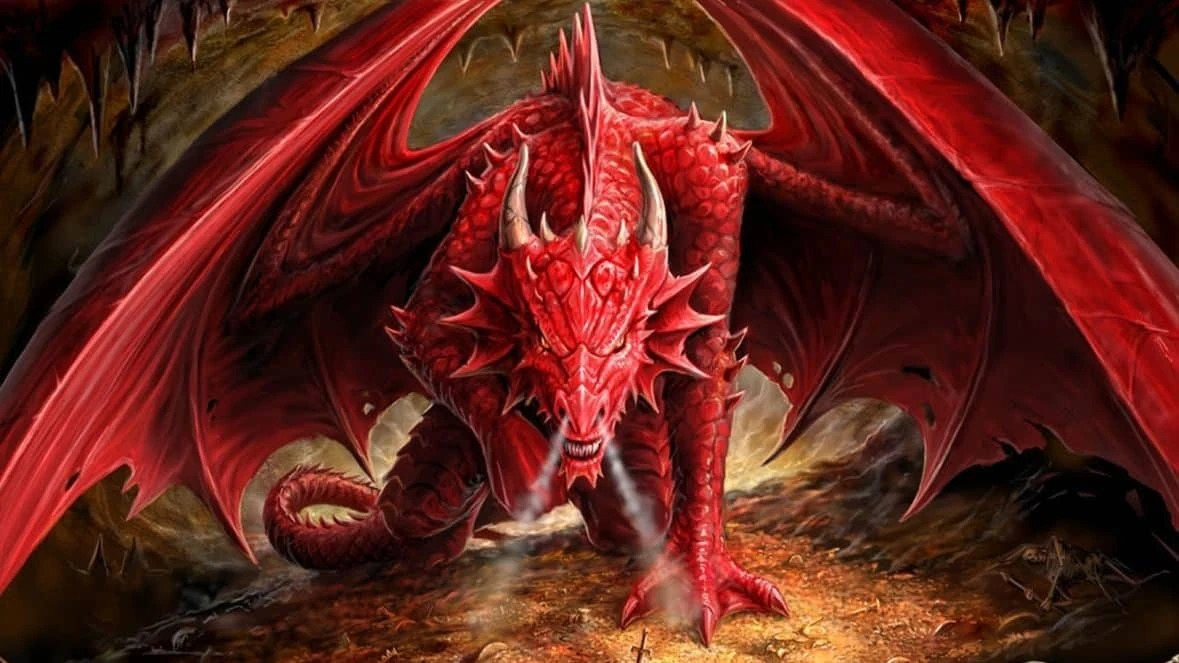
Tiamat: Primordial Sea Goddess
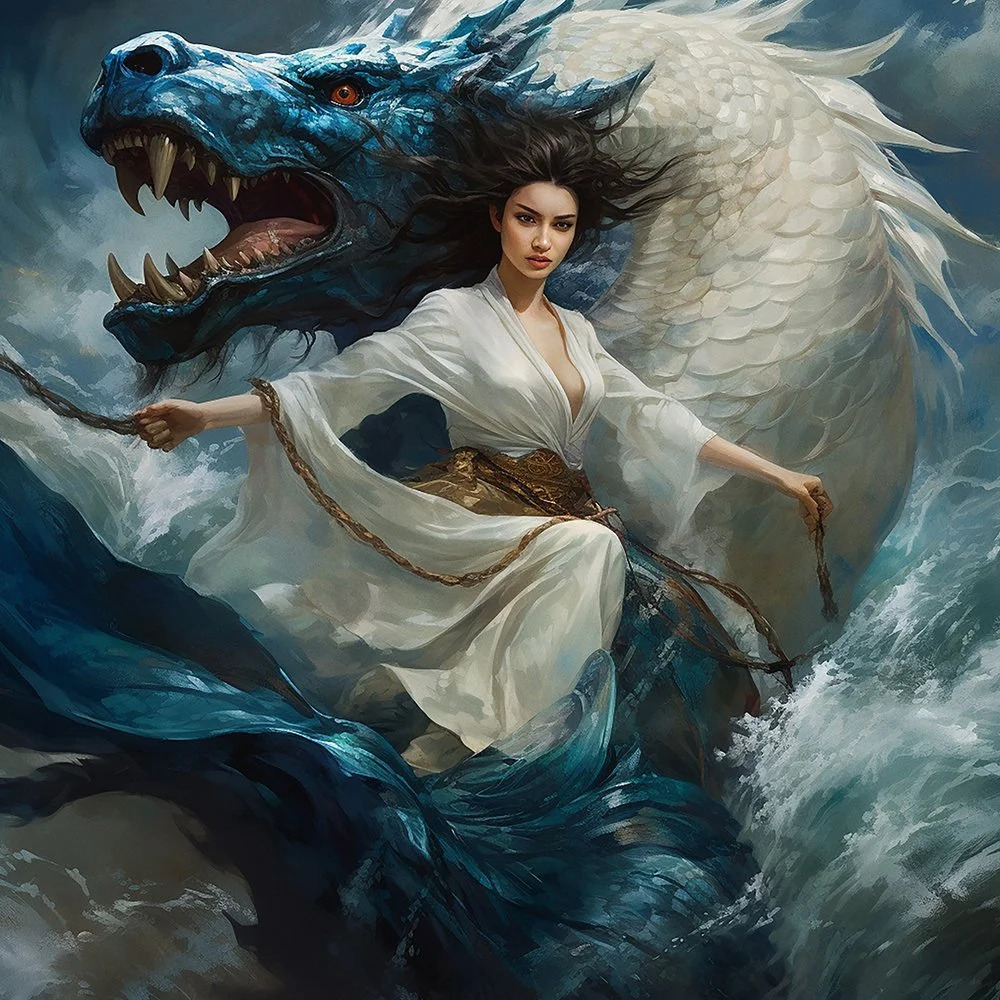
Between the great Euphrates and Tigris rivers of Mesopotamia dwelled a great goddess during Mesopotamian times. The embodiment of the sea, Tiamat is the mother of the gods of Mesopotamia, and usually depicted as a serpent or large aquatic dragon. She is known by different names and titles, one being Ummu-Hubur, meaning Mother-Watercourse
, the creator of primordial water and life. In the creation story of the culture, the Enuma Elish, she mates with the primordial god of groundwater, Apsu. From this union, the gods of the first civilization were born.
However, they were a noisy bunch. Apsu grew enraged with their constant talking and fighting, and sought to kill them all so he could be at peace. He is killed, which angers Tiamat, who fights her own children in vengeance for her fallen spouse. She births eleven monsters to fight the gods, several of which are reptilian, snakelike, or draconic: Basmu Venomous Snake
, Usumgallu Great Dragon
, Musmahhu Exalted Serpent
, and Mushussu Furious Snake
.
Alongside her consort Qingu, Tiamat waged war against her kin, brandishing the Tablet of Destinies as a weapon. The Tablet holds the power of fate and divine rulership. The Tablet is stolen by Anu, god of the sky; later claimed to be Enlil, god of the earth, wind, air, and storms; and Marduk, god of creation, justice, water, agriculture, magic, and medicine.
Marduk is the one most attributed to Tiamat’s subsequent defeat, beating the fearsome goddess with a large club, arrows of wind, a net, and a spear.
Tiamat’s body was later used for many parts of the physical world by the gods. As a primordial goddess, she could not die, but lived on as important landmarks for ancient people. Her ribs became the physical heavens and earth, her eyes the sources of the Tigris and Euphrates Rivers, and her tail the star-specked Milky Way.
Tiamat birthed the gods from her dark waters, waged war in creation times, and finally died to become the land humans now walk upon. In modern times, she is known to be a multi-headed, winged dragon in the Dungeons & Dragons game. A full life, as the mother of gods would have, because as she birthed from the sea, so she returned to water.
Dragon Killers: A Fairy Tale Matrix
The English word dragon comes from the Latin term draco, meaning huge serpent
, which is based on the Greek word drakon, meaning serpent, giant seafish
. From these etymological definitions, the dragon is concluded to be a creature of aquatic origin, but different from its fishy relatives by being the bane of man’s existence.
Fairy tales, myths, and local legends mark various differences among their draconic creations. Some breathe fire like the classical Western dragon, others are extremely strong and fast, a few have multiple heads like the infamous Lerneian Hydra slain by Heracles, and a couple have deadly poison that kills whoever it touches. These differences mark the evershifting view of dragons, but focus on the deadliness of the beasts to the people who encounter them.
Many heroes in fairy tales possess two main attributes that allow them to overcome the ferocity of their draconic foes: 1. They have abilities greater than an ordinary person. This can be because of behavior (virtuous spirit) or birth (demigod powers). 2. Their actions are not for personal gain but for a higher purpose. This is shown in the saintly slaying of dragons (as they are representations of the Devil) or in the heroic killing of dangerous beasts to protect innocent civilians (like the slaying of Cetus by Perseus to rescue Andromeda).
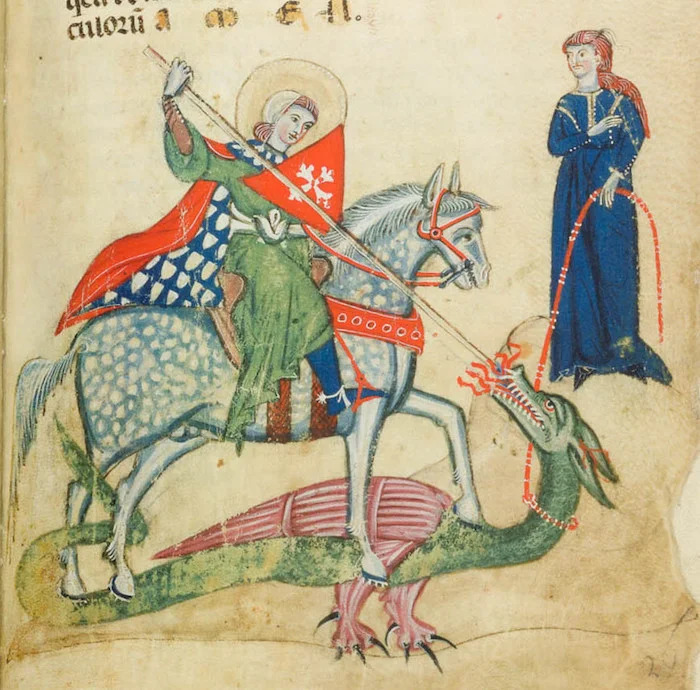
A famous tale told throughout Spain is the one of Saint George and the Dragon, the oldest version dating to a Georgian text in the 11th century. As a loyal Christian knight in Roman Europe, George ventured across the land. One day, he passes a crying woman. The woman is a local princess, chosen to be a horrible dragon’s tribute offering. She tells George that the dragon has been extorting her village for years, asking for meat and gold; yet when the townspeople ran out of cattle and trinkets, they created a lottery system to select human offerings each day. The princess was that day’s lottery loser. Even as the princess begged him to flee, George turned towards the cave and fought the dangerous dragon. He prevailed over the serpent, rescuing the princess and her town. George later became a Saint in the Christian tradition, featured on flags across Europe as a novel story about overcoming difficulty.
The dragons and men who kill them are fierce, dichotomous foes. The dragons are the old, archaic, wild ways of nature and lawlessness, while the men are the virtuous, faithful, and heroic people who save innocents from slaughter. This matrix, the theme of foes locked in endless battle throughout time, fighting for their own ideals, has lasted for thousands of years and continues to the modern day. While the valiant knight may fall for the dragon in modern stories (thank you, Shrek), many tales exist of the struggle between old and new, wild and tame, chaotic and virtuous.
This post is based on the academic article Formation of the Fairy Tale Matrix of a Dragon Slayer
by Polona Tratnik in 2022. Citation: Tratnik, P. (2022). Formation of the Fairy Tale Matrix of a Dragon Slayer. Acta Histriae, 30(3), 565-587. https://doi.org/10.19233/AH.2022.24
Fafnir: From Man to Beast
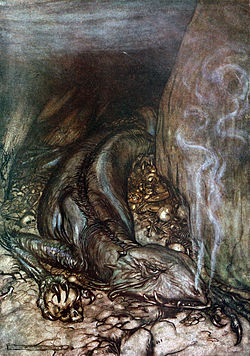
Many people have wanted the ability to shift into a dragon, right? Well, Fafnir did not.
In the Nordic mythology of Northern Europe, the dwarf Fafnir lived with his father Hreithmarr and living brother Regin. His other brother, Otr, was accidentally killed by a trio of gods, who gifted Hreithmarr a hoard of treasure as a weregild (blood-price, a gift received in penance for the killing of someone).
Many people have wanted the ability to shift into a dragon, right? Well, Fafnir did not.
In the Nordic mythology of Northern Europe, the dwarf Fafnir lived with his father Hreithmarr and living brother Regin. His other brother, Otr, was accidentally killed by a trio of gods, who gifted Hreithmarr a hoard of treasure as a weregild (blood-price, a gift received in penance for the killing of someone).
Fafnir grew jealous of his wealthy father and killed him. Fafnir took the treasure to a cave in the wilderness, hiding it away from humanity. However, a magical ring within the hoard called to Fafnir, enticing him to put it on. Once he did, he began to transform into a beast of scales: a wyrm/worm/ormr, the Nordic dragon. Legless and slithery like a gigantic snake, Fafnir hid in his cave, only venturing out to find food.
Regin sought the help of Sigurth, a hero, and forged the sword Gram to slay the beast. However, Sigurth couldn’t simply strike at Fafnir’s steel-strong scales, so he hid in a pit covered with leaves. When the draconic beast slithered over the pit, Sigurth stabbed upwards, impaling Fafnir’s body on the sword and killing him.
Later, while cooking the dragon’s heart for its magical properties, Sigurth licks some blood from his finger after testing if the heart is finished cooking. The blood grants Sigurth the ability to understand birds, who tell him of Regin’s future betrayal. Fearing death, Sigurth kills Regin in his sleep, then takes the cursed hoard for himself, even after Fafnir warned him twice of its evil.
Sigurth is later killed for trickery by his wife, leading to the end of the treasure’s curse.
This sad tale gave rise to the Ring, Smaug, Bilbo, and Gollum in Lord of the Rings. Many seek the Ring for its magical properties (much like the gold treasure), Smaug is a fierce dragon defending his hoard (like Fafnir), Bilbo seeks the ring and Smaug’s destruction (like Sigurth and Regin), and Gollum falls into madness and changes form because of his greed for the Ring (also like Fafnir).
The story of Fafnir warns against greed and murder, two very important lessons for a peaceful life.